Why UK Organisations Are Betting on Global Tech Teams for Strategic Advantage
There has been a shift in how UK technology leaders talk about offshore hiring. The conversation is no longer primarily about cost. It is about capability — and increasingly, about competitive positioning.
For much of the last decade, offshore development was framed as a way to reduce headcount spend. That framing has not disappeared entirely — but it has been overtaken by a different and more sophisticated argument. The organisations betting most heavily on global tech teams in 2026 are doing so because they cannot build the capability they need from domestic talent alone.
The Domestic Talent Picture
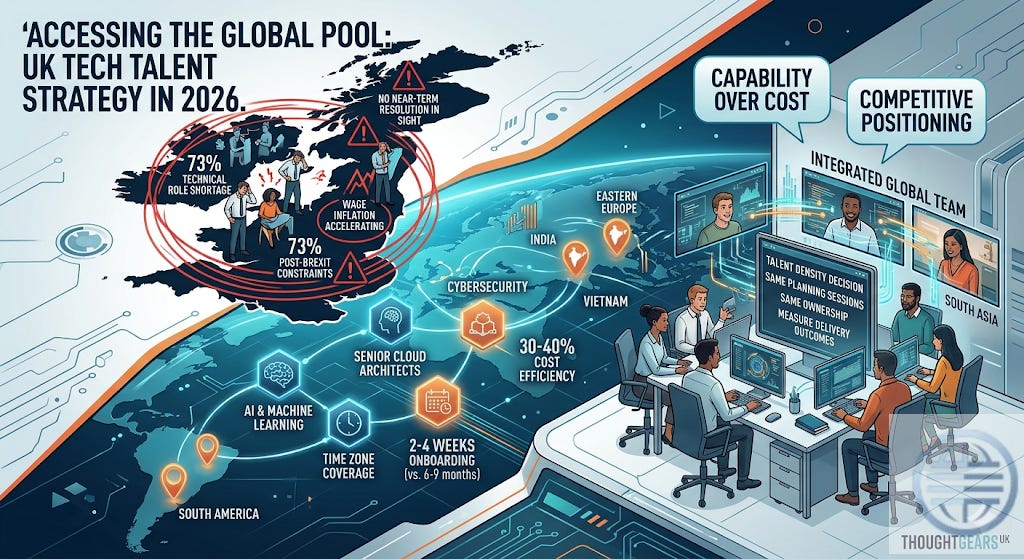
The UK faces a structural technology talent shortage with no near-term resolution in sight. Seventy-three per cent of UK employers report difficulty filling technical roles, with shortages in engineering and IT projected to persist through at least 2032.
Post-Brexit constraints have compounded the problem. The removal of EU freedom of movement has meaningfully reduced the pool of European talent available to UK organisations without visa sponsorship. Wage inflation in the technical talent market has also accelerated, with salaries for mid-senior engineers significantly above CPI in each of the past three years.
The result is that UK organisations relying exclusively on domestic hiring are consistently slower to build technical capability than competitors who access global talent pools. In a market where speed of delivery is a competitive variable, this matters.
Why the Strategic Framing Has Shifted
The shift from transactional outsourcing to integrated global teams reflects a genuinely different operating model.
In the transactional model, offshore talent is engaged to complete defined tasks — the relationship is arm’s-length. In the integrated model, offshore engineers work as part of the client’s team — attending the same planning sessions, using the same tools, contributing to architecture decisions, and carrying ownership of their work in the same way a London-based team member would.
When engineers understand context — why a feature matters, what the broader product strategy is, how the system fits together — the quality of their decisions improves. Transactional models strip that context. Integrated models preserve it.
What Global Teams Give UK Organisations
Access to specialised skills. AI and machine learning engineers, senior cloud architects, and cybersecurity specialists are considerably more accessible through offshore and nearshore channels than through the domestic UK market alone.
Speed of team-building. A domestic hiring cycle for a senior engineer currently averages six to nine months. Established offshore partners can onboard qualified engineers within two to four weeks.
Cost efficiency as a multiplier. Effective offshore hiring typically runs 30 to 40 per cent below the cost of equivalent in-house operations — meaning the same budget builds a larger, more capable team.
Time zone coverage. For organisations supporting global operations, teams spread across time zones provide genuine operational coverage that a single-location team cannot.
The Talent Density Argument
Expanding to a global talent model allows organisations to access strong engineers who have not yet been bid up by the London market — building teams where the proportion of high-capability contributors is higher than domestic-only hiring would allow. The Silicon Review’s analysis of 2026 tech hiring trends makes this explicit: the leading technology organisations are not treating offshore talent as a budget decision. They are treating it as a talent density decision.
Making the Shift Work in Practice
The organisations achieving the strongest results from global tech teams invest in integration, not just placement. They treat offshore engineers as permanent team members — with career development conversations and genuine inclusion in product decisions. They measure delivery outcomes, not location proximity.
The organisations betting on global tech teams in 2026 are not cutting corners. They are making a deliberate strategic choice to build technical capability in a way that domestic hiring alone cannot support. The talent is there. The tools to integrate it effectively are there. For UK technology leaders, the question is no longer whether global teams are viable. It is whether you are using them as effectively as your competitors.
FAQs
Q: Why are UK organisations increasingly using offshore tech teams?
The domestic talent market cannot meet demand, particularly for AI, cloud, and cybersecurity skills. 74% of UK employers report difficulty filling technical roles, with shortages expected through 2032.
Q: Is offshore hiring still primarily about cost in 2026?
No — the strategic rationale has shifted. While offshore hiring does run 30–40% below equivalent in-house costs, the primary drivers are access to specialised skills, speed of team-building, and talent density.
Q: What is the difference between transactional outsourcing and integrated global teams?
Transactional outsourcing uses offshore talent to complete defined tasks at arm’s length. Integrated global teams embed offshore engineers directly into the client’s team — using the same tools, attending the same planning, owning work the same way.
Q: How does Brexit affect UK access to tech talent?
Post-Brexit removal of EU freedom of movement has meaningfully reduced the pool of European candidates available without visa sponsorship, adding time and cost to hiring processes that are already slow.
Q: What is “talent density” and why does it matter?
Talent density refers to the concentration of high-capability individuals in a team. Global hiring allows organisations to access strong engineers who have not yet been bid up by the London market, building teams where the ratio of high-capability contributors is higher.
Q: How quickly can a global tech team be built compared to domestic hiring?
Established offshore partners can onboard qualified engineers within two to four weeks. Domestic hiring for senior technical roles currently averages six to nine months in the UK market.
Q: What makes integrated offshore teams outperform transactional outsourcing?
Context. When offshore engineers understand the broader product strategy, architecture decisions, and customer requirements, the quality of their technical decisions improves significantly.
Q: What practices distinguish the best-performing global tech teams?
Investment in integration — not just placement — treating offshore engineers as permanent team members with career development pathways, and measuring delivery outcomes rather than proximity.
Q: Is there a risk of quality loss when using global tech teams?
In poorly managed arrangements, yes. In well-structured partnerships with strong onboarding and outcome-based performance measurement, quality is consistently comparable to co-located teams.
Q: Which regions offer the strongest global tech talent for UK organisations?
Eastern Europe (Poland, Ukraine, Romania), South and South-East Asia (India, Vietnam, Philippines), and Latin America are the most established. The right region depends on the specific skill set, time zone overlap, and cost parameters.