The 87% Confidence Gap
In 2026, the most common blocker in tech careers is not a lack of opportunity. It is not a lack of skill. It is confidence erosion — and it is endemic.
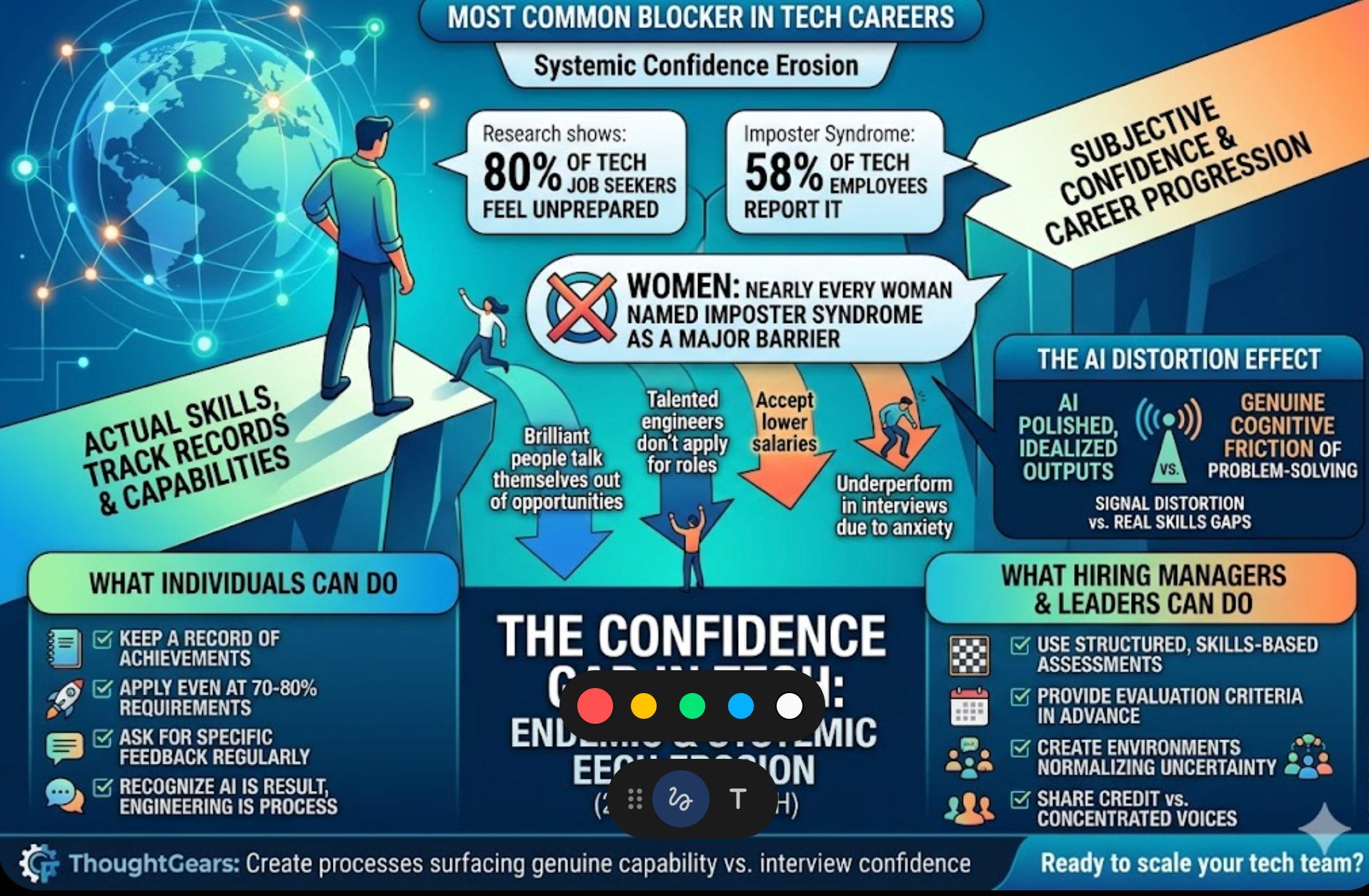
Research shows that 80% of tech job seekers feel unprepared when entering the market. Fifty-eight per cent of tech employees report experiencing imposter syndrome at some point in their career. Among women, the numbers are even more stark: nearly every woman surveyed in one study named imposter syndrome as a major barrier to entering and advancing in tech.
These numbers are not a psychological curiosity. They have real consequences: talented engineers who don’t apply for roles they are qualified for, capable people who accept lower salaries because they doubt their value, strong candidates who perform below their ability in interviews because anxiety overwhelms their preparation.
In a talent market where the shortage is structural and severe, the confidence gap is waste — brilliant people talking themselves out of opportunities, and organisations missing talent they could have had. This article explores where the gap comes from, why it has deepened in 2026, and what both individuals and leaders can do about it.
The Scale of the Problem
The confidence gap in tech is not a new phenomenon, but the data from 2026 suggests it has deepened. Eighty per cent of tech job seekers report feeling unprepared when entering or re-entering the job market — a figure that reflects not so much a genuine skills deficit as what researchers have started calling “systemic confidence erosion.”
When Feeling Unprepared Becomes the Norm
The striking thing about the 80% figure is not its size — it’s what it represents. Many of these job seekers have real skills, demonstrable track records, and genuine capability. The feeling of being unprepared is not, in most cases, an accurate assessment of their readiness. It is a perception problem — one that modern hiring systems and the current technological environment have, in many ways, made worse.
Why This Matters Beyond the Individual
The confidence gap has systemic consequences. When talented engineers don’t apply for roles, don’t negotiate salaries, don’t put themselves forward for senior positions, or underperform in interviews due to anxiety — the talent market loses quality it sorely needs. In an industry where 73% of employers are struggling to hire, the engineers who self-select out due to unwarranted self-doubt represent a real and measurable cost.
What Imposter Syndrome Actually Is — and Isn’t
Imposter syndrome — the persistent feeling that you are not as competent as others perceive you to be, and that you will eventually be “found out” — was first documented in high-achieving women in the 1970s. Fifty years later, 58% of tech employees report experiencing it. It is one of the most widespread psychological phenomena in the industry.
The Classic Pattern in Tech
The classic imposter syndrome pattern in tech looks like this: a developer completes a piece of work that their colleagues regard as excellent. Their internal experience of that work is of gaps, shortcuts, lucky guesses, and unresolved uncertainty. They attribute the outcome to circumstance rather than capability. The next project feels just as uncertain. The sense that “I’ve got away with it so far” never quite resolves.
This pattern is self-reinforcing. The more evidence of competence accumulates, the more skilled imposter syndrome becomes at explaining it away. Senior developers are not immune — some research suggests that high achievers are more susceptible, not less, because they are most aware of the complexity of what they don’t know.
How It Shows Up at Every Career Stage
At junior level, imposter syndrome manifests as reluctance to speak up in code reviews, unwillingness to take on stretch assignments, or avoidance of job applications for roles that feel like a reach. At senior level, it shows up differently: in reluctance to move into engineering management, in deflecting credit for team outcomes, in underselling in salary negotiations. At every stage, the underlying mechanism is the same: a gap between objective capability and subjective confidence.
Why Women Carry a Heavier Burden
The aggregate imposter syndrome statistics obscure an important disparity: women in tech report it at significantly higher rates than men, and the consequences for their careers are correspondingly more severe.
The Numbers Are Stark
In one survey by Tech Returners, nearly 100% of the 250 women who participated named imposter syndrome as a major barrier to entering or re-entering tech. Research from LeadDev and others consistently shows that women in male-dominated professions report significantly higher rates of professional self-doubt than those in more gender-balanced environments.
Structural Causes, Not Personal Failings
It would be a mistake — and an unkindness — to treat this as a personal psychological failing. The confidence deficit that many women experience in tech is, in large part, a rational response to a structural environment. Working in a field where your presence is statistically unusual, where role models who look like you are scarce, and where subtle and not-so-subtle signals about who “belongs” in certain rooms are common — these are genuine confidence-eroding experiences. The solution is not individual resilience training. It is changing the structural conditions.
The AI Distortion Effect
One newer driver of confidence erosion in 2026 deserves particular attention: the effect of AI tools on how developers assess their own capabilities.
How AI Tools Are Making the Confidence Gap Worse
Generative AI produces polished, coherent, seemingly expert outputs. When developers compare their own working process — messy, iterative, full of dead ends and course corrections — to the clean artefacts that AI generates, many conclude that they fall short. What they are actually experiencing is a comparison with an output that has none of the cognitive friction of genuine problem-solving. It’s like comparing your draft to someone else’s finished copy.
Signal Distortion vs. Real Skills Gaps
The researchers who identified this effect describe it as “signal distortion” — AI shows idealised outputs rather than the messy reasoning and trade-offs that real problem-solving involves. Candidates who have been trained on AI outputs measure themselves against an unrealistic standard and conclude they fall short. The result is diminished self-trust rather than diminished skill. The skill is there. The calibration is off.
Recalibrating — for Professionals and the Leaders Who Hire Them
The confidence gap is not inevitable. For both individuals experiencing it and the leaders responsible for the environments that produce it, there are practical things that make a material difference.
What Individuals Can Do
Keep a record of specific things you have built, fixed, and learned. Return to it when confidence is low. The evidence of competence is more reliable than the feeling of it. Apply for roles even when you meet only 70–80% of the stated requirements — stated requirements are often wish lists, and many high-performing hires don’t meet every criterion. Ask for feedback regularly and specifically, so you are calibrating against external reality rather than internal anxiety. And recognise the AI distortion effect: the messy, uncertain, iterative process you experience is engineering. The polished output is the result, not the process.
What Hiring Managers and Leaders Can Do Differently
Hiring managers can significantly reduce the confidence gap’s effect on their talent pipeline by using structured, skills-based assessments rather than abstract interviews that reward confidence over capability. Giving candidates context about what good looks like — beforehand, not after — dramatically reduces the performance anxiety that causes strong candidates to underperform. And inside teams, creating environments where uncertainty is normalised, questions are welcomed, and credit is shared rather than concentrated in the most confident voices — these are the structural changes that move the dial over time.
The confidence gap in tech is wide, well-evidenced, and costly — for the individuals caught in it and for the organisations trying to hire their way through a constrained talent market. Eighty per cent of tech job seekers feeling unprepared is not a statement about the quality of the talent pool. It is a statement about the environment that has been built around it.
The gap is not fixed by exhortations to “believe in yourself.” It is fixed by changing the systems — hiring processes, team cultures, leadership behaviours — that create and sustain it.
Ready to scale your tech team? Get in touch with ThoughtGears — we’d love to hear about your project.
FAQs
Q: What is the confidence gap in tech?
The confidence gap refers to the widespread disparity between tech professionals’ actual capabilities and their subjective assessment of those capabilities. Research shows that 80% of tech job seekers in 2026 feel unprepared — a figure that largely reflects systemic confidence erosion rather than genuine skills deficits.
Q: What is imposter syndrome and how common is it in tech?
Imposter syndrome is the persistent feeling that you are not as competent as others perceive you to be — that your successes are attributable to luck or circumstance rather than genuine ability. Fifty-eight per cent of tech employees report experiencing it. It is one of the most common psychological patterns in the industry.
Q: Why do women in tech experience higher rates of imposter syndrome?
Women in tech report significantly higher rates of professional self-doubt than men, with research showing nearly 100% of women in some surveys naming it as a major barrier. This reflects structural factors — working in a male-dominated environment where role models are scarce and where subtle signals about who “belongs” are common — rather than personal failings.
Q: How are AI tools making the confidence gap worse?
AI tools produce polished, idealised outputs that developers compare against their own messy, iterative working process. This creates “signal distortion” — candidates measure themselves against an unrealistic standard (the AI output) rather than the genuine cognitive work of engineering, leading to unwarranted diminished self-trust.
Q: How does imposter syndrome affect career progression in tech?
Imposter syndrome leads to underapplication for roles (not applying for positions you’re qualified for), underperformance in interviews due to anxiety, underselling in salary negotiations, and avoidance of stretch assignments and senior roles. Each of these effects is measurable in career trajectory — and collectively they represent significant lost potential.
Q: What practical steps can developers take to address imposter syndrome?
Keep a specific record of what you have built, fixed, and learned — and consult it when confidence is low. Apply for roles even when you meet 70–80% of the requirements. Seek regular, specific feedback to calibrate against external reality. Recognise the AI distortion effect and understand that the messy process of engineering is normal, not a sign of inadequacy.
Q: What can hiring managers do to reduce the impact of the confidence gap?
Use structured, skills-based assessments that reward demonstrated capability over interview confidence. Give candidates context about evaluation criteria in advance to reduce anxiety. Provide feedback to unsuccessful candidates where possible. These practices improve the quality of your hire pipeline and make it more representative of available talent.
Q: Does imposter syndrome affect senior engineers as well as junior ones?
Yes — and some research suggests high achievers are more susceptible, not less, because they are most aware of what they don’t know. At senior level, imposter syndrome often manifests differently: as reluctance to move into management, deflection of credit, or avoidance of salary negotiation. The mechanism is the same, the expression differs.
Q: Is the confidence gap a mental health issue?
It sits at the intersection of psychology and culture. For some individuals, it is associated with anxiety or other mental health experiences. For most, it is a cognitive pattern produced by environmental factors — systemic hiring practices, AI comparison culture, and structural underrepresentation — rather than a clinical condition. Addressing it requires both individual strategies and systemic change.
Q: How does ThoughtGears think about the confidence gap in its work?
ThoughtGears works with candidates and clients to create hiring processes that surface genuine capability rather than rewarding interview confidence. We advocate for skills-based assessment and structured hiring practices — not just because they produce better diversity outcomes, but because they consistently identify better engineers.