Managing Global Distributed Teams: The Async-First Playbook UK Tech Leaders Are Adopting in 2026
Most UK tech teams that struggle with offshore engineers don’t have a talent problem. They have a management problem.
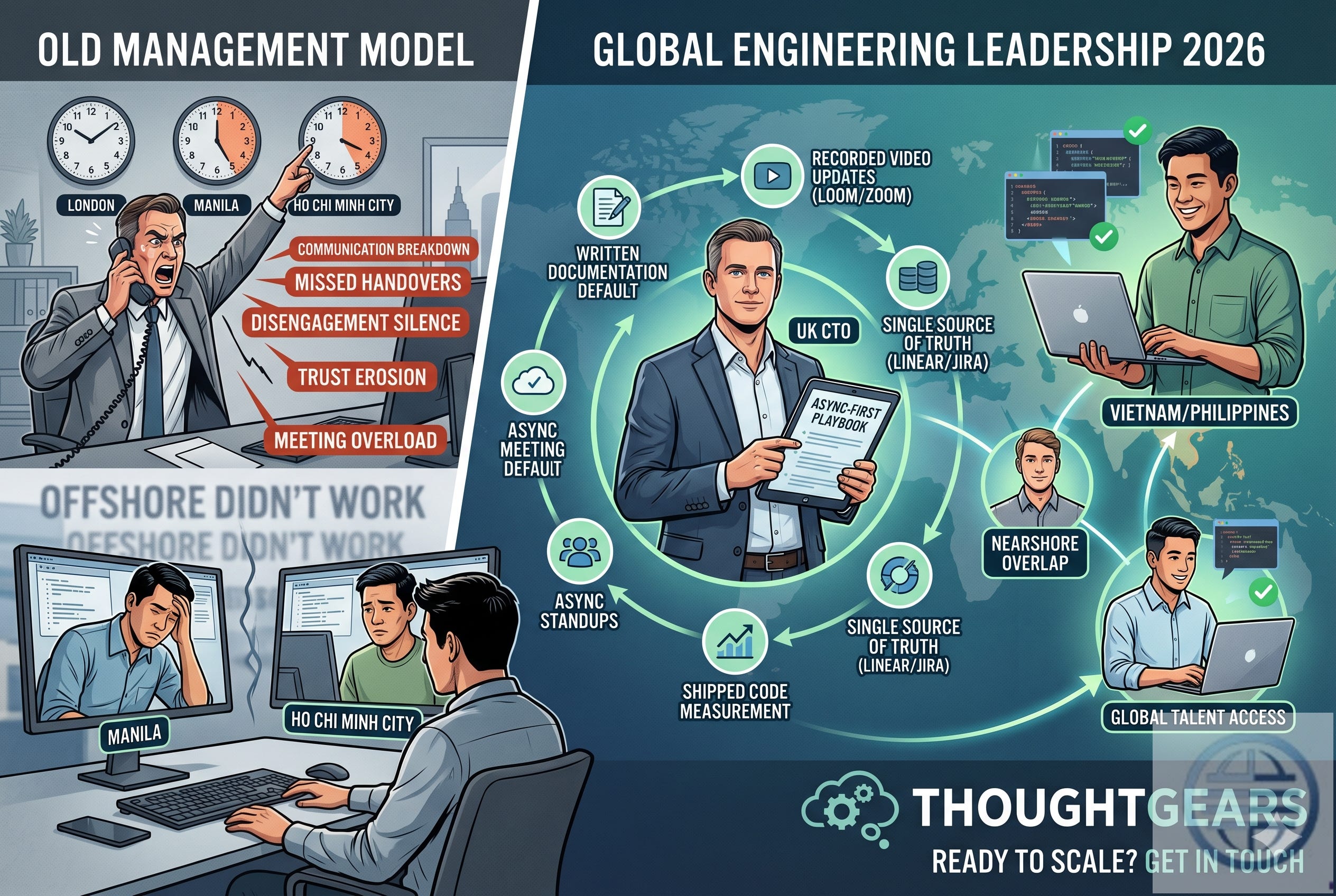
Distributed teams fail when leaders try to run them like a co-located London office that happens to have a few people in Manila. The meetings don’t fit. The handovers leak information. The silence between time zones gets read as disengagement when it’s actually focus. Within six months, the trust erodes and someone announces that “offshore didn’t work” — when what didn’t work was the operating model.
The leaders running successful global tech team management in 2026 have built something different. They’ve gone async-first by design. They’ve turned time zone gaps into a coverage advantage. They’ve stopped measuring engineering output in hours and started measuring it in shipped code. Distributed team productivity isn’t a soft skill — it’s a system, and the system is teachable.
This is the playbook the most effective UK CTOs are using right now to run remote engineering management at scale. Read it once, apply two ideas this week, and you’ll see the difference within a quarter.
Why Distributed Teams Need a Different Operating Model
The biggest mistake UK leaders make with offshore teams is treating distance as a problem to be solved with more meetings. It isn’t. Managing distributed teams well means accepting that synchronous time is your scarcest resource — and protecting it.
When your senior engineer is in London and your build team is in Ho Chi Minh City, you have roughly three to four hours of overlap per day. Spending two of those hours on standups and status meetings leaves you with almost no real working time. The standard agile cadences that work for co-located teams actively damage remote engineering management.
The solution is to invert the default. Make async the standard mode. Treat synchronous time as a precious tool used for collaboration, decision-making, and relationship-building — not for status reporting. Distributed team productivity rises sharply when leaders stop replicating the office in Slack and start designing for distance.
This is more than a process tweak. It’s a cultural shift that changes how decisions get made, how knowledge gets shared, and how trust gets built. The companies that succeed treat the model as foundational, not optional.
The Async-First Principles That Make It Work
Async-first management rests on five practical principles you can implement this quarter.
First, write things down. Decisions, context, designs, blockers — all in shared documents, not chat threads. If a piece of information lives only in someone’s head or in a deleted Slack message, your distributed team is operating on borrowed time.
Second, replace daily standups with written updates. Async standups in Slack or Linear, posted by each engineer at the start of their day, give every team member visibility regardless of time zone. They take five minutes to read versus 30 minutes to attend.
Third, default to recorded video for anything that needs nuance. Loom, Zoom Cloud Recordings, or even iPhone screen captures let an engineer in Bangkok watch a 7-minute walkthrough of architecture decisions instead of waiting 18 hours for the next live meeting.
Fourth, establish clear response time expectations. Not everything is urgent. A 24-hour response window for non-blocking decisions is normal in good distributed teams.
Fifth, document the asynchronous workflow itself. Write down how your team works, where information lives, and what “done” looks like. This document is your single most valuable management asset.
Industry data shows 64% of enterprises now adopt remote staffing as standard practice, and the teams getting it right are the ones treating async as a discipline, not a fallback.
Designing Your Time Zone Strategy
Smart cross-timezone management starts with deliberate hub design rather than accidental geography.
The UK sits in a uniquely useful position for global teams. London is GMT, which means: 5–7 hours behind East Coast US, 7–9 hours ahead of West Coast US, 4–7 hours ahead of South-East Asia, and 1–2 hours behind Eastern Europe. With careful design, you can run an effective global engineering operation from this single anchor point.
The most common winning configuration in 2026 looks like this: a senior UK leadership team, a delivery team in South-East Asia (Vietnam, Indonesia, the Philippines), and optionally a smaller European team for nearshore overlap. Timezone overlap teams built this way get 3–4 hours of high-quality synchronous time daily, plus continuous async progress.
Avoid the trap of placing your entire offshore team in a single time zone with zero UK overlap. The 12-hour gap configurations sound efficient on paper but kill collaboration. Global team collaboration works best when you design for at least 3 hours of overlap with the team’s primary leadership.
If you’re hiring in Vietnam or the Philippines, you have natural overlap with UK afternoons and evenings. That’s a feature, not a bug — it gives your engineers full quiet mornings for deep work and a productive overlap window for decisions.
Onboarding Offshore Engineers the Right Way
Most offshore developer management UK failures happen in the first 30 days, not month six.
The leaders who get it right invest disproportionately in onboarding. Day one isn’t about giving someone a laptop and a Jira login. It’s about setting them up for autonomous decision-making. Offshore team integration at this stage requires four things.
First, assign a named integration lead from the UK team for the first 90 days. This person isn’t a manager — they’re a friend in the system who answers small questions quickly and accelerates the new engineer’s confidence.
Second, document everything an engineer needs to be productive in their first two weeks: architecture overviews, environment setup, naming conventions, code review standards, who to ask about what.
Third, run a structured first project with explicit success criteria and a paired review at the end. How to manage offshore developers well always includes a clear early win.
Fourth, schedule the first synchronous video call inside 24 hours of start date and make it about people, not process. Trust gets built in face-to-face conversation. The rest is async.
Industry research suggests the quality of a partner’s onboarding process is the single most reliable proxy for how seriously they manage long-term delivery. It’s worth evaluating before you sign any contract.
Day-to-Day Practices That Lift Productivity
Once your team is running, these practical habits separate high-performing distributed teams from average ones.
Managing remote developers well means treating documentation as a deliverable, not an afterthought. Every PR description should include context. Every architectural decision should land in a written ADR (architecture decision record). Every Slack thread that resolves a question should be summarised back into the docs.
Use a single source of truth for work status. Whether you choose Linear, Jira, or Shortcut, the rule is one tool, no exceptions. Nothing kills distributed team productivity like having to check three places to know if something is done.
Build in dedicated relationship time. A monthly 1:1 with each engineer, focused on career growth not project status, costs you 30 minutes and buys you 12 months of retention. Annual in-person team gatherings — even short ones — pay for themselves many times over in trust and retention.
Set explicit team rituals. Friday demo recordings. Monthly architecture reviews. Quarterly retrospectives. These become the rhythm that holds the team together across time zones.
Finally, measure what matters. Cycle time, deployment frequency, change failure rate — the DORA metrics — work just as well for distributed teams as for co-located ones. Stop measuring presence. Start measuring throughput.
Running a successful global distributed team isn’t about technology, time zones, or even hiring. It’s about operating discipline. The UK tech leaders who are scaling their teams across continents in 2026 aren’t doing anything magical — they’re being more deliberate. They write things down. They protect synchronous time. They design for overlap. They onboarded well. They measure throughput, not presence.
The reward is real. Tech CTO global team strategies that work give you access to the best engineers regardless of geography, around-the-clock progress, and significantly lower run rates than UK-only hiring. The shift to async-first management is one of the most consequential operating model changes UK tech leaders are making this decade.
Start small. Pick two practices from this playbook. Apply them in the next two weeks. Measure the difference. The teams that learn to operate this way will be the ones that ship the most software in the years ahead.
Ready to scale your tech team? Get in touch with ThoughtGears — we’d love to hear about your project.
FAQs
What does async-first management actually mean in practice?
It means treating written, asynchronous communication as the default and synchronous meetings as the exception.
How many hours of time zone overlap do I need with an offshore team?
Aim for at least 3 hours of overlap per day with your core leadership.
Should I use daily standups for distributed teams?
Replace synchronous standups with written async standups posted to Slack or your project tool.
What’s the biggest mistake UK leaders make with offshore engineers?
Treating them as outsiders or “just hands” rather than full team members.
How do I build trust with engineers I rarely see?
Invest heavily in onboarding, schedule regular 1:1s focused on career growth, and make annual in-person gatherings a non-negotiable budget line.
Which tools are essential for managing distributed teams?
A single project tool (Linear, Jira, or Shortcut), a written communication hub (Slack or Teams), a documentation system (Notion or Confluence), and a video tool that supports recordings (Loom or Zoom).
How do I measure productivity in a distributed team?
Use the DORA metrics: deployment frequency, lead time for changes, change failure rate, and mean time to recovery.
Is South-East Asia a good region for UK distributed teams?
Yes. The time zone offers 3–4 hours of UK afternoon overlap, English proficiency is high, and the talent pool has grown rapidly.
How do I handle urgent issues across time zones?
Define what counts as urgent versus normal upfront. Set up a clear on-call rotation if you run a production service.
What’s the first thing I should change if my distributed team isn’t performing?
Audit your meeting load. If you’re spending more than 25% of synchronous overlap time on status updates, replace those with async written updates immediately.
⚠️ Disclaimer
This article is for general guidance only. ThoughtGears is not a legal, employment law, or financial adviser. Practices around offshore employment, contractor compliance, and cross-border tax vary by jurisdiction — always seek qualified professional advice before making decisions affecting your team, contracts, or compliance posture.