From Cost Centre to Competitive Edge
The conversation around offshore development has been dominated for decades by one word: cost. Go offshore, spend less. Simple.
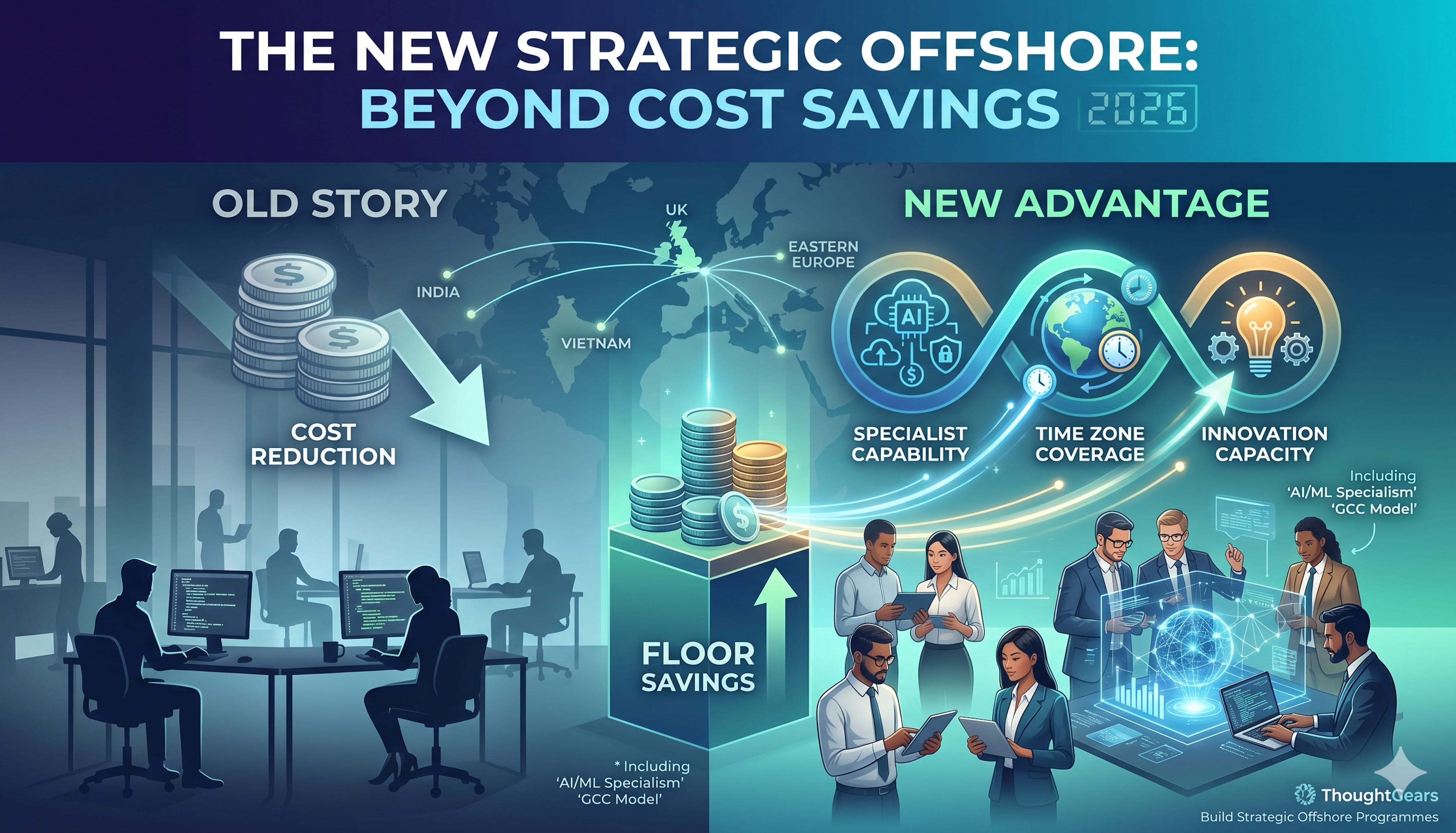
That framing has never been entirely wrong, but it has always been incomplete. And in 2026, it is becoming actively misleading. The organisations that are getting the most from their offshore programmes are not treating them as cost reduction exercises. They are treating them as strategic assets — sources of specialist capability, time zone coverage, and innovation capacity that domestic hiring alone cannot provide.
The worldwide IT skills shortage is projected to affect 90% of organisations by 2026. In that environment, the question of where you find your engineering talent is no longer primarily a cost question. It is a capability question. The businesses that figure this out — that move past the cost centre mental model and start building genuinely strategic offshore programmes — will have an advantage that their competitors cannot easily replicate.
This article is a guide to that shift: what it looks like in practice, what it requires from leadership, and how UK businesses can build offshore development programmes that are genuinely more than the sum of their cost savings.
The Old Story About Offshore Is Over
The traditional offshore narrative went something like this: labour costs in India (or wherever) are lower than in the UK, so if you can move development work there, you can produce the same output for less money. The appeal was simple and the economics were real — for a certain kind of work, performed in a certain way.
What “Offshore” Used to Mean
In practice, the traditional model often meant large, relatively commoditised development organisations producing high volumes of code to specification. The work that got offshored was typically well-defined, repetitive, and easily measured: maintenance, testing, build-and-run infrastructure. The offshore team was, in the truest sense, a cost centre — valued primarily for what it didn’t cost, rather than what it created.
Why the Narrative Has Changed
Three things have happened simultaneously to make this model obsolete. First, the talent shortage has reached a point where domestically constrained organisations genuinely cannot hire the engineers they need — at any price. Second, the specialisations that matter most in 2026 (AI/ML, cloud-native architecture, advanced cybersecurity) are not exclusively available in the UK, and are in some respects better represented in offshore markets. Third, the era of large, undifferentiated development shops producing commodity code is ending, displaced by smaller, more specialised teams working with AI tools that dramatically amplify individual productivity. The offshore landscape has changed, and the strategy for accessing it needs to change with it.
The Economics Still Matter — But They’re Not the Point
It would be wrong to dismiss the financial case for offshore development. The economics are real, and they matter — particularly in an environment of rising domestic developer salaries and constrained technology budgets.
What the Numbers Actually Look Like in 2026
An equivalent offshore engineer in a managed development model typically costs between $61,600 and $79,200 per year. The equivalent UK-based engineer — at mid-to-senior level in London or major tech hubs — will typically cost $150,000–$200,000 per year when you include salary, employer National Insurance, benefits, and office costs. The saving, per engineer, can exceed $100,000 annually. For a team of ten engineers, that represents over $1 million per year — capital that can be reinvested in growth, product, or additional headcount.
Offshore development centres also typically deliver 40–60% overall cost savings compared to equivalent Western operations when you factor in all employment costs, infrastructure, and management overhead.
When Cost Savings Are a Floor, Not a Ceiling
Here is the reframe that matters: the cost savings should be treated as a floor — the minimum benefit of an offshore programme, the baseline case. Everything above the cost saving — the specialist capability you access, the time zone coverage you gain, the innovation capacity you build — is additional value. Organisations that treat cost savings as the ceiling of what offshore can deliver are leaving enormous value on the table.
From Execution Engine to Strategic Asset
The organisations that are running the most effective offshore programmes in 2026 share a common characteristic: they don’t treat their offshore teams as execution machines. They treat them as part of a global engineering organisation with the same standards, culture expectations, and career development investment as any other team.
Why the Best Offshore Programmes Don’t Feel Like Outsourcing
The distinction between a high-performing offshore programme and a traditional outsourcing relationship is visible in day-to-day operations. In a transactional outsourcing relationship, the offshore team receives tickets, produces output, and reports on delivery. Communication is formal. The offshore team is a supplier.
In a high-performing offshore programme, the offshore team participates in planning, contributes ideas, owns technical decisions within its scope, and has engineers who are known by name to their onshore counterparts. The work is genuinely collaborative. The offshore team is a team — part of the same engineering organisation, with the same access to leadership, the same visibility into product direction, and the same opportunities to develop and advance.
The Shift in What Gets Offshored
The era of using offshore centres for general coding capacity is ending. The organisations pushing the frontier are using offshore talent for specialised, high-value work: AI and machine learning development, cloud-native architecture, data engineering, advanced cybersecurity. These are the areas where the global talent pool is deepest and where the value of finding the right person far exceeds the value of finding a cheaper person.
Building Offshore AI and Specialist Capability
The most significant strategic opportunity in offshore development in 2026 is not labour arbitrage — it is access to specialist expertise that the domestic UK market cannot supply at the volume required.
The Demand for Specialist Expertise
AI and machine learning skills are the hardest to find in the UK in 2026, cited as the most acute shortage by 19% of organisations. The domestic pipeline for ML engineers, AI product managers, and cloud-native architects is severely constrained. Offshore markets — particularly Vietnam, India, and Eastern Europe — have strong specialist communities in these areas. The best offshore programmes are being built around accessing these communities, not around replacing commodity development capacity.
Why Offshore Markets Are Well Positioned to Deliver It
Several factors make offshore markets attractive for specialist AI and cloud work. First, the best offshore engineers in these fields have often worked on projects for global technology companies — they are not isolated from the frontier of practice. Second, the cost of senior specialist talent offshore is significantly below the UK equivalent, which means organisations can afford the depth of specialisation they need. Third, the offshore markets with the strongest AI and cloud specialisms are themselves experiencing growing demand, which means their talent is being developed and deepened, not just exported.
The Always-On Advantage
One of the most underrated benefits of a well-structured offshore programme is time zone coverage — the ability to have engineering capacity active across more of the 24-hour cycle than a purely domestic team can provide.
Time Zone Coverage as a Structural Benefit
An always-on capability across time zones is a structural advantage that companies with purely domestic teams cannot replicate without paying premium overtime rates. With engineers in Eastern Europe (GMT+1 to GMT+3), Asia (GMT+5.5 to GMT+9), and the UK, an organisation can effectively operate a continuous development cycle — with work progressing while the onshore team sleeps, and handoffs structured to capture every productive hour.
What This Looks Like in Practice
For customer-facing technology businesses, always-on development means faster response to production incidents, shorter release cycles, and the ability to respond to urgent product changes with less delay. For internal technology organisations, it means longer effective sprints, more throughput per calendar week, and reduced pressure on onshore engineers to work extended hours to meet deadlines. The always-on model requires investment in communication design — clear handoffs, comprehensive documentation, asynchronous standup formats — but organisations that get it right gain a structural delivery advantage.
Culture, Integration, and Making It Work as One Team
The most common reason offshore programmes fail to reach their potential is not technical capability. It is culture and integration. The offshore team is treated as a separate entity, communication is formal and infrequent, and the gap between “us” (onshore) and “them” (offshore) never closes.
The Failure Mode Nobody Talks About
The classic failure mode looks like this: a UK business sets up an offshore team, the team delivers reasonable output, but there is a persistent sense that “things would be better if they were here.” The offshore team lacks context about product direction. Communication runs through a single point of contact. Offshore engineers don’t speak up in reviews because they have never been invited to. The relationship is functional but not genuinely integrated.
The result is a programme that captures the cost benefits of offshore but none of the capability benefits. And because the relationship never develops real depth, it is fragile — the first significant delivery problem becomes a reason to question whether the offshore model was ever a good idea.
What Genuine Team Integration Requires
Integration requires deliberate investment across several dimensions. Communication structure: offshore team members should participate directly in product discussions, not just receive work through intermediaries. Visibility: offshore engineers should have direct access to product roadmaps, architectural decisions, and business context. In-person time: at least one or two structured visits per year — either onshore engineers visiting the offshore team or vice versa — dramatically accelerates relationship-building in ways that video calls cannot replicate. Career development: offshore engineers should have the same access to learning resources, internal promotions, and leadership opportunities as their onshore counterparts. Teams that invest in these dimensions build offshore capability that compounds over time.
Building a Global Capability Centre Mindset
The most mature expression of strategic offshore development is the Global Capability Centre (GCC) model — a dedicated offshore entity with its own leadership, culture, and long-term development roadmap, fully integrated into the parent organisation’s engineering strategy.
What GCCs Get Right That Standard Offshore Models Don’t
Global Capability Centres are not transactional offshore relationships. They are long-term strategic investments with their own talent development programmes, internal engineering culture, and leadership career paths. They are increasingly central to enterprise digital transformation strategies — not just executing work handed to them, but driving innovation programmes, leading AI integration initiatives, and owning significant areas of the product roadmap.
The GCC model delivers cost efficiency, specialist capability, and time zone coverage — but it delivers them within a governance structure that treats the offshore entity as a genuine part of the business, not a supplier. This distinction produces better engineers (who stay longer and develop faster when they feel like real team members), better products (developed with full business context), and better business outcomes.
How to Evolve Your Programme Over Time
Most organisations that eventually run high-performing offshore programmes did not start there. They started with a small offshore team, learned what worked, and evolved their model over time. The trajectory typically runs: initial team extension or project outsourcing → dedicated managed team → integrated offshore capability → global capability centre. Each stage builds on the last, and the transition from one to the next is driven by learning and investment, not just size.
The key principle at each stage is to treat the offshore team as a genuine part of your organisation — with all that implies for communication, culture, and career development — rather than as a vendor relationship to be managed at arm’s length.
The businesses that are thriving in the current talent environment are not the ones trying hardest to hire domestically. They are the ones that have figured out how to build genuinely global engineering organisations — using offshore and nearshore talent not as a cheaper version of their domestic team, but as a complementary capability with its own strengths.
The shift from cost centre to competitive edge is not a matter of attitude. It is a matter of design: how you structure your offshore relationships, how you integrate offshore teams into your organisation, and how you invest in the culture and capability that makes the difference between a functional offshore programme and a genuinely transformative one.
Ready to scale your tech team? Get in touch with ThoughtGears — we’d love to hear about your project.
FAQs
Q: What does it mean to move from treating offshore as a cost centre to treating it as a competitive advantage?
The cost centre model values offshore development primarily for what it saves — lower labour costs compared to domestic hiring. The competitive advantage model treats offshore as a source of specialist capability, time zone coverage, and innovation capacity that domestic hiring alone cannot provide. The cost savings become a baseline benefit, not the ceiling.
Q: What are the actual cost savings from offshore development in 2026?
An equivalent offshore engineer in a managed development model typically costs $61,600–$79,200 per year, compared to $150,000–$200,000 for a mid-to-senior UK developer when all employment costs are included. The saving per engineer can exceed $100,000 annually; for a team of ten, that exceeds $1 million per year.
Q: Why is the traditional offshore model becoming obsolete?
The traditional model — using offshore for large volumes of commodity development work — is being disrupted by AI tools that reduce the value of high-volume, low-complexity coding, the growing importance of specialist expertise (AI, cloud, cybersecurity), and a talent market where domestic constrained organisations need offshore access to skills, not just to save money.
Q: What specialist capabilities are best accessed through offshore development in 2026?
AI and machine learning engineering, cloud-native architecture, data engineering, and advanced cybersecurity are the areas where offshore talent pools are deepest and where the value of specialist expertise is highest. These are the specialisations that the domestic UK market cannot supply at the volume required.
Q: What is the “always-on” advantage of offshore development?
An organisation with engineering teams across multiple time zones can effectively operate a continuous development cycle — with work progressing while the onshore team sleeps, and structured handoffs that capture every productive hour. This delivers shorter release cycles, faster incident response, and more throughput without requiring extended hours from any individual.
Q: Why do so many offshore programmes fail to reach their potential?
The most common reason is poor integration — the offshore team is treated as a separate vendor rather than a genuine part of the engineering organisation. Communication is formal and infrequent, context is not shared, and offshore engineers are not invited to participate in planning, architectural decisions, or product discussions. The result is a programme that captures cost benefits but none of the capability benefits.
Q: What is a Global Capability Centre (GCC)?
A GCC is a dedicated offshore entity with its own leadership, culture, talent development programme, and long-term roadmap, fully integrated into the parent organisation’s engineering strategy. GCCs are increasingly central to enterprise digital transformation — not just executing work, but owning significant areas of the product and technology roadmap.
Q: How important is in-person time for making offshore relationships work?
Very important. Research and practitioner experience consistently show that in-person visits — either offshore engineers visiting the UK team or vice versa — dramatically accelerate relationship-building in ways that video calls cannot replicate. Most well-run offshore programmes invest in at least one or two structured in-person engagements per year.
Q: What does genuine offshore team integration look like in practice?
Offshore engineers participate directly in product discussions, not just receive tickets. They have direct access to roadmaps, architectural decisions, and business context. They have the same access to career development opportunities as onshore counterparts. And communication is designed for genuine collaboration — not routed through a single onshore-offshore interface.
Q: How does ThoughtGears help UK businesses build strategic offshore programmes?
ThoughtGears works with UK tech businesses across the full journey — from placing the first offshore hire to helping clients design team structures that scale effectively. We provide access to vetted global talent, advise on model selection (team extension, dedicated team, GCC), and help clients build the kind of offshore relationships that compound in value over time.