AI and Junior Developers: Why 2026 Demands a Different Kind of Early-Career Support

Tech graduate jobs in the UK have dropped 46% from 2024 levels, with a further 53% drop projected for 2026. Stanford Digital Economy Lab data shows entry-level tech postings down 67% between 2023 and 2024. Employment for 22–25 year olds in tech has fallen 13% since late 2022.
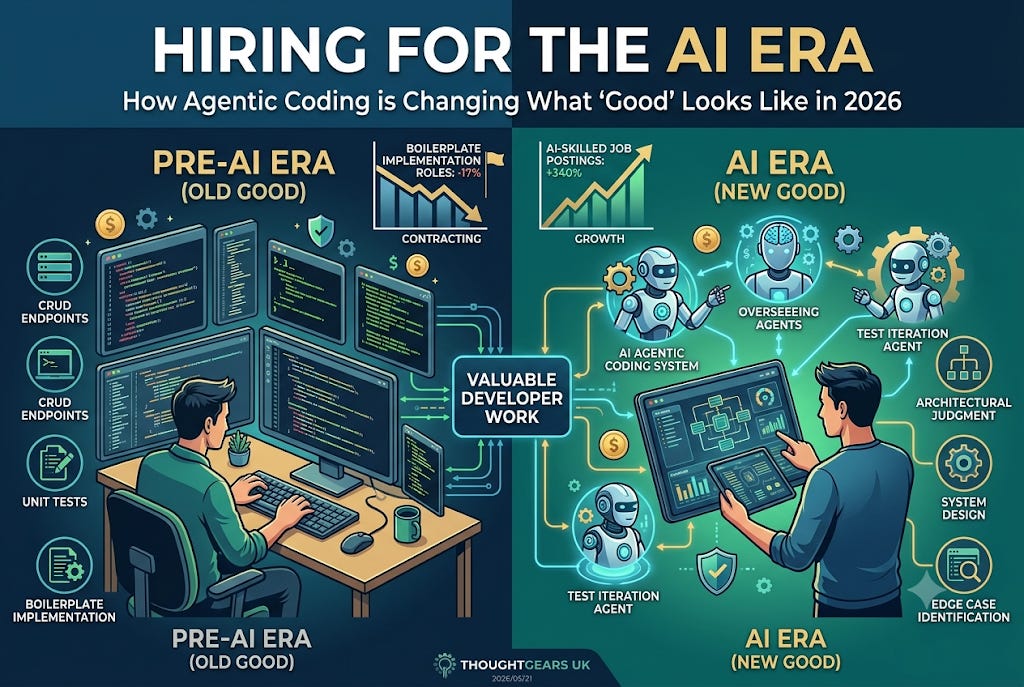
This is the most disruptive shift to early-career tech in a generation, and it’s being driven primarily by one factor: AI tools have absorbed much of the basic coding work that used to define junior developer roles. CRUD endpoints, boilerplate, simple bug fixes — the work that used to give a junior six months of context — now takes a senior plus AI a couple of hours.
If you’re a junior developer trying to break into the industry, this can feel terrifying. If you’re a tech leader who needs to build a healthy talent pipeline, it should worry you for different reasons. A profession that stops hiring juniors stops producing seniors, and that’s a problem the entire industry will feel by 2030.
This article is for both groups. Here’s what’s actually happening, what skills now matter most, and how to build a career — or a team — that works in this new reality.
What’s Actually Happening to Junior Tech Jobs
The numbers tell a stark story. The Institute of Student Employers reports a 46% drop in UK tech graduate jobs from 2024, with another 53% decline projected through 2026. The trend is global — Stanford research shows entry-level tech job postings down 67% in just one year between 2023 and 2024.
What’s driving this? Three forces.
First, AI productivity gains. Senior developers with Copilot or Claude can produce code at a rate that previously required a senior plus 1–2 juniors. The economic logic is straightforward: companies hire fewer juniors when the work juniors traditionally did can now be handled by AI-augmented seniors.
Second, the cost dynamic. Training a UK junior costs significant time and money before they’re productive. With graduate tech jobs UK under pressure, many companies have shifted budget to senior hiring or to AI tooling — both of which deliver immediate output.
Third, the shift in entry-level work. The junior tech jobs decline isn’t uniform. Demand for skilled juniors who are AI-fluent and can contribute meaningfully from week one is actually holding up. The decline is concentrated in roles that expect candidates to learn slowly over months while doing simple, repetitive work.
This isn’t the end of junior careers. It’s the end of one specific model of junior careers.
How AI Has Changed What Juniors Need to Learn
The traditional junior developer learning curve — learn syntax, learn frameworks, learn debugging, learn architecture — assumed years of slow exposure to a codebase. AI compresses that curve, but it also raises the bar for what counts as a productive junior.
The first major shift: AI impact on junior developers is biggest in routine work. Boilerplate, basic CRUD, simple test scaffolding — AI does this faster than a junior. Trying to compete with AI on these tasks is a losing strategy.
The second shift: AI accelerates learning when used well. Learning to code with AI — using it as a tutor, code reviewer, and debugger — lets juniors progress faster than was previously possible. The Peng et al. 2023 study found junior developers benefited more from Copilot than seniors did, in proportional terms.
The third shift: judgement matters more than typing speed. AI can produce code; it can’t always produce correct code, secure code, or code that fits your team’s standards. Junior developers who learn to evaluate AI output critically — to spot the 29% of generated Python with security weaknesses, for example — become valuable quickly.
How junior developers should adapt to AI is the central question. The answer isn’t to avoid AI tools. It’s to use them strategically, building deep understanding alongside the speed AI provides.
The New Skills That Matter Most in 2026
The skills that distinguish successful junior developer career 2026 trajectories are different from the ones that mattered five years ago.
AI fluent junior developer capability is now the foundation. This means knowing which AI tools work for which tasks, writing effective prompts, evaluating AI-generated code critically, and understanding when to use AI versus when to write code from first principles. Microsoft’s research showing 71% of business leaders prefer AI-fluent juniors over more experienced non-AI engineers makes the priority clear.
Strong fundamentals still matter — arguably more, not less. Computer science fundamentals, data structures, algorithms, and system design help a junior understand whether AI’s suggestions are correct. Without that foundation, you’re stuck reviewing code you can’t evaluate.
Communication and product thinking are increasingly important. Junior developers who can describe problems clearly, ask sharp questions, and translate business requirements into technical decisions are vastly more valuable than ones who just write code.
AI coding career advice in 2026 always includes: pick a specialism. Generalist juniors compete with AI. Specialists in modern frontend, security, data engineering, or AI/ML engineering have clearer career paths and stronger demand.
The other underrated skill: writing. Documentation, ADRs (architecture decision records), clear PR descriptions, and effective async communication separate strong juniors from weaker ones in distributed teams.
Building a Career Path That Works
The standard junior-to-senior career path was: 2 years junior, 3 years mid-level, then senior. That model still works, but the milestones look different now.
Junior software engineer roadmap for 2026: in your first year, build deep AI tool fluency, master version control and collaboration tools, contribute meaningfully to a real codebase, and pick your initial specialism. By year two, you should be leading small projects independently, mentoring even more junior team members, and demonstrating clear judgement in choosing when to use AI versus when not to.
The career compression is real. How to become a senior developer has become possible faster than ever for the right people because AI accelerates the learning curve. Five-year senior promotions are no longer rare for genuinely talented juniors.
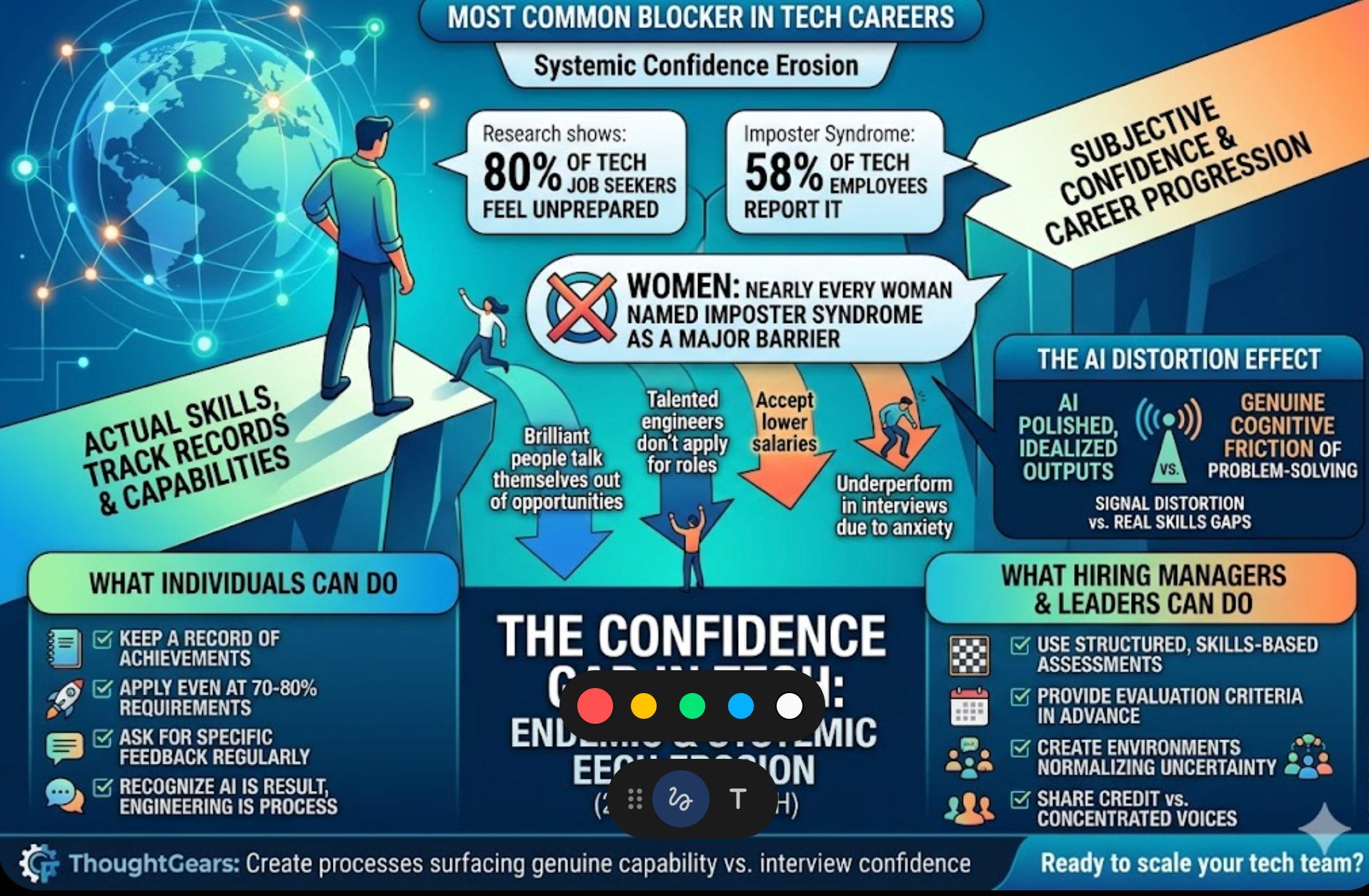
The risks are also real. Microsoft Research suggests it takes 11 weeks for developers to realise AI productivity gains. Junior developers who lean too heavily on AI without building underlying understanding can plateau early — they look productive, but they can’t debug complex issues, design systems, or work without their tools.
Building skills as junior developer in this environment requires a balance. Use AI to learn faster. Don’t use it to skip learning entirely. The juniors who develop both strong fundamentals and strong AI fluency are the ones who become the most valuable seniors three years out.
Where Tech Leaders Should Invest in Junior Talent
For UK tech leaders, the collapse in junior hiring is a long-term problem disguised as a short-term cost saving.
A profession that stops training juniors stops producing seniors. The salary inflation already pricing UK senior engineers out of reach will get worse, not better, if the entire industry stops developing entry-level talent. Building junior tech talent is a strategic investment in your own future cost base.
Several ways to invest sensibly without breaking budgets.
First, hire fewer juniors but invest more deeply in each one. A 3-junior cohort with strong mentoring beats a 10-junior cohort with no support. Pair them with senior engineers, give them real ownership of projects, and treat their development as a key deliverable.
Second, look at junior developer offshore opportunities. Junior engineers in South-East Asia and Eastern Europe are typically more available, cost-effective, and often AI-fluent earlier in their careers because they’ve had to compete globally. A blended team of UK seniors and offshore juniors is often a better operating model than a UK-only team in either direction.
Third, redesign onboarding. The 11-week AI productivity ramp-up applies to juniors too. Build structured 90-day programmes that combine fundamentals, AI tool training, and progressively challenging real work.
UK tech early career support hasn’t kept pace with the market shift. Companies that get this right will have a meaningful talent advantage by 2028.
The collapse in junior tech hiring is one of the most consequential shifts in our industry, but the response shouldn’t be despair. For junior developers, the path forward is clear: build deep AI fluency, develop strong fundamentals, pick a specialism, and find environments that invest in your growth. For tech leaders, the strategic move is to maintain a thoughtful junior pipeline rather than abandoning it under short-term cost pressure.
The teams that find the balance — combining experienced seniors using AI well with carefully selected, well-mentored juniors — will outperform both extremes. The companies treating juniors as an investment rather than an expense will have the talent advantage when the inevitable next cycle of growth begins.
If you’re a junior developer reading this, the opportunities are real but different. Build the skills that matter. Find the teams that invest in early-career growth. Don’t let headlines about AI replacing developers convince you to give up. The talent gap is widening, not closing.
Ready to scale your tech team? Get in touch with ThoughtGears — we’d love to hear about your project.
FAQs
Are junior developer jobs really disappearing?
They’re being significantly compressed, not disappearing entirely. UK tech graduate jobs dropped 46% from 2024, but demand for AI-fluent juniors with strong fundamentals remains.
Should I still try to become a software developer in 2026?
Yes, but with a different approach. Focus on AI fluency from day one, build deep fundamentals, and develop a specialism early.
Which specialisms are best for new junior developers?
AI/ML engineering, modern data engineering, cybersecurity, and modern frontend all show strong long-term demand.
How much should juniors rely on AI tools?
Use AI tools constantly as a learning accelerator, but don’t outsource thinking to them.
What’s the fastest way to become a senior developer in 2026?
Combine deep AI tool fluency with strong fundamentals, work on real production systems with senior engineers, and develop clear communication and product thinking.
How do tech leaders justify hiring juniors when AI exists?
Because today’s juniors are tomorrow’s seniors. A profession that stops training juniors creates a senior shortage in 5 years.
Are offshore juniors a good option for UK companies?
Often yes. Junior engineers in Southeast Asia and Eastern Europe are typically AI-fluent, cost-effective, and available.
What’s the right ratio of seniors to juniors in 2026?
The old 2:1 senior-to-junior ratios have shifted toward 4:1 or 5:1 in many teams.
How long should it take a junior to become productive?
With strong AI tools and good onboarding, juniors can contribute meaningfully within 4–6 weeks and run independent projects within 4–6 months.
Will the junior job market recover?
It will rebalance, not return to 2018 patterns. Demand for AI-fluent juniors with strong fundamentals will grow.
⚠️ Disclaimer
This article reflects opinion and analysis based on publicly available data current at the time of writing. Career outcomes vary significantly by individual, market, and circumstance. ThoughtGears is not a career, legal, or financial adviser. Always seek qualified professional advice for decisions affecting your career, business hiring practices, or talent investment strategies.