Agentic Coding Is Here
Something significant has shifted in how software gets written. Twelve months ago, AI coding assistants were productivity tools. Today, agentic coding systems are executing multi-step development tasks autonomously — writing code, running tests, interpreting errors, and iterating on their own output.
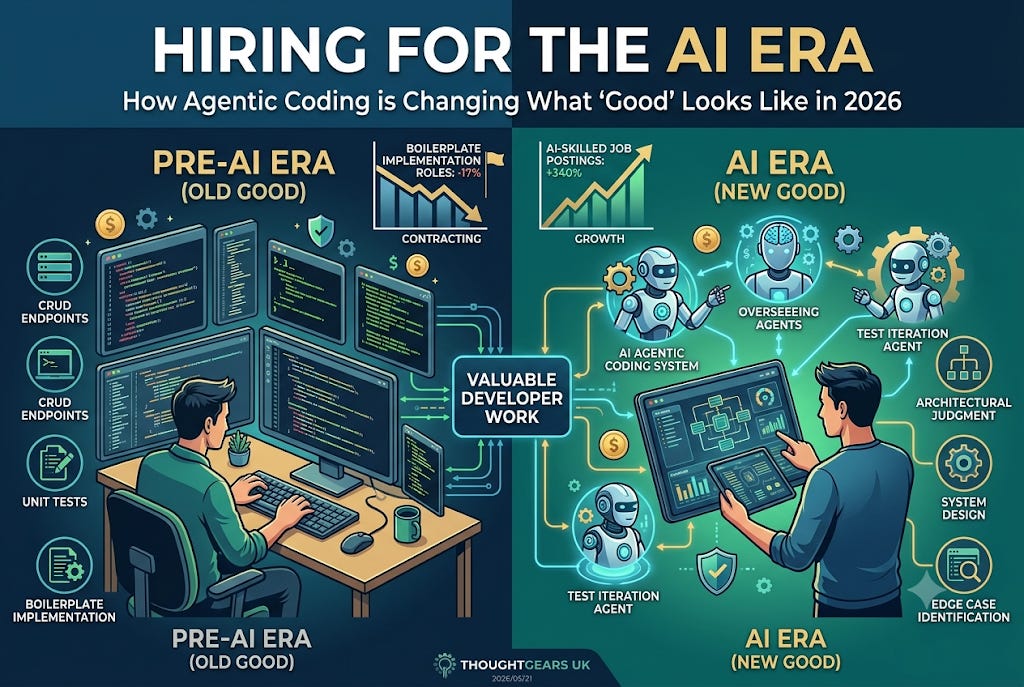
This isn’t theoretical. The AI coding tools market has grown from $5.1 billion in 2024 to $12.8 billion in 2026. Job postings requiring experience with AI coding tools have increased by 340% in just twelve months. And postings for pure implementation roles — developers hired primarily to translate specifications into code — have fallen by 17%.
The nature of valuable developer work is changing. The question for every technology leader is: are you hiring for the skills that matter in this new environment, or are you still optimising for the old one?
The AI Coding Market Has Exploded — Here’s the Data
The speed of change in the AI coding tools landscape has been remarkable. In 2024, the market was substantial but nascent. By 2026, it has more than doubled — reaching $12.8 billion — and the tools available to developers have transformed in both capability and adoption rate.
From Autocomplete to Autonomous Agents
The first generation of AI coding tools were sophisticated autocomplete systems. They accelerated the writing of individual functions and reduced the friction of looking up documentation. Useful, but incremental. The current generation is categorically different. Agentic coding systems can receive a high-level objective, break it into constituent tasks, write and execute code, run tests, interpret failure messages, and iterate — with minimal human intervention at each step.
What “Agentic Coding” Actually Means
The term “agentic” describes AI systems that can take sequences of actions, make decisions, and use tools — rather than simply responding to a single prompt. In a coding context, this means a developer can describe what they want to build, and the agent works to build it — handling many of the routine sub-tasks that previously consumed a significant portion of an engineer’s time. The developer’s role shifts towards specifying, reviewing, and refining, rather than implementing from scratch.
How Developer Job Descriptions Are Changing
The labour market data tells a clear story. Job postings requiring experience with AI coding tools have increased by 340% year-on-year. At the same time, postings for pure implementation roles — where the primary expectation is writing code to a specification — have declined by 17%.
Roles That Are Contracting
The roles most affected are those where the primary value was the ability to write boilerplate quickly: basic CRUD endpoints, unit tests for well-defined functions, straightforward front-end components. These tasks are increasingly handled by agentic systems, or by junior developers using AI tools at near-senior output levels. Standalone roles built around this kind of work are contracting.
Roles That Are Growing
The roles growing in demand are those requiring judgment, architecture, and oversight of AI systems: engineers who can design systems, evaluate AI-generated code for correctness and security, make trade-off decisions, and integrate AI workflows into larger engineering processes. The ability to work effectively alongside AI tools — to direct them, verify their output, and recognise when they’ve gone wrong — is now a core professional competency.
What This Means for Hiring Decisions
For technology leaders making hiring decisions right now, the shift has concrete implications. The profile of the developer who adds the most value has changed, and hiring processes that haven’t kept pace will produce the wrong outcomes.
The Shift in What “Good” Looks Like
In the pre-AI era, a strong developer was primarily someone who could produce high-quality code efficiently. That remains important, but it is no longer sufficient. In 2026, a strong developer is also someone who can direct AI tools effectively, review their output critically, design systems that AI can work within, and make architectural decisions that go beyond what any current AI can do reliably.
Senior Engineers Have Never Been More Valuable
There is a somewhat paradoxical effect playing out: AI tools are making senior engineers more productive at the same time as they’re raising the baseline expectations of what good looks like. The experienced engineer who can architect a system, identify the edge cases an AI agent will miss, and course-correct when an agentic workflow goes off the rails — this person is more valuable than ever. And they are in shorter supply than ever.
Using AI to Make Your Team More Effective
The organisations that are gaining the most from AI coding tools are those that treat them as a genuine strategic investment in team productivity, not just a line item in the software budget.
AI as a Force Multiplier
A senior engineer working with well-configured AI coding tools can operate at significantly higher throughput than the same engineer without them. The leverage is particularly high for tasks that are repetitive but require context — refactoring, test coverage, documentation, code review. This doesn’t mean you need fewer senior engineers; it means your senior engineers can take on more ambitious projects.
Pair Programming With Machines
The working model that is emerging for the most effective teams is a kind of continuous pair programming between developers and AI systems. The developer holds the architectural context and the quality bar; the AI handles a growing proportion of the implementation. Getting this dynamic right requires engineers who understand both what the tools are capable of and where their limits are — a new kind of technical fluency that hiring processes need to test for.
Hiring for the AI Era
The implications for talent acquisition are significant. You need to be hiring differently — and in some cases, in different places.
What to Look for in AI-Era Developers
When evaluating developers in 2026, look for evidence of system-level thinking, an ability to work with and critically evaluate AI-generated code, strong communication skills (particularly around architectural decision-making), and genuine curiosity about the tools that are reshaping the field. These are the signals that distinguish developers who will compound in value from those whose role will narrow.
The Offshore Angle
The AI era is also changing the economics of offshore hiring. Developers in markets like Vietnam, the Philippines, and Eastern Europe who are working effectively with AI tools can deliver at a quality and velocity that would have required more senior profiles just two years ago. For UK tech businesses, this opens up offshore talent pools in a more versatile way than before — provided you’re hiring for AI-era competencies, not just traditional coding skills.
Agentic coding is not a future consideration — it’s the present reality of software development in 2026. The market has grown more than 150% in two years, job descriptions are changing at pace, and the developer profile that creates the most value has shifted decisively towards system thinking, AI collaboration, and architectural judgment.
Tech leaders who recognise this shift and adjust their hiring criteria accordingly will build teams that compound in capability. Those who don’t will keep hiring for a world that no longer exists.
Ready to scale your tech team? Get in touch with ThoughtGears — we’d love to hear about your project.
FAQs
Q: What is agentic coding?
Agentic coding refers to AI systems that can autonomously execute multi-step coding tasks — breaking down objectives, writing code, running tests, interpreting error messages, and iterating on output — with minimal human intervention at each step. It represents a significant evolution from earlier AI autocomplete tools.
Q: How big is the AI coding tools market in 2026?
The AI coding tools market reached $12.8 billion in 2026, more than doubling from $5.1 billion in 2024. Job postings requiring experience with AI coding tools increased by 340% between January 2025 and January 2026.
Q: Are AI coding assistants replacing developers?
No — but they are changing what developers are hired to do. Postings for pure implementation roles have declined by 17%, while demand for developers who can architect systems, evaluate AI-generated code, and orchestrate agentic workflows has grown significantly. AI is a force multiplier, not a replacement.
Q: What skills do developers need in the AI coding era?
The most valuable skills in 2026 are system design, architectural judgment, the ability to direct and critically evaluate AI tools, and strong communication around technical decision-making. Pure coding speed is now less differentiated; the ability to work effectively alongside AI systems is increasingly essential.
Q: How should hiring processes change to reflect the AI coding era?
Technical assessments should evaluate system-level thinking and the ability to review AI-generated code, not just the ability to produce code from scratch. Interviews should probe architectural judgment, AI tool fluency, and how candidates approach problems that go beyond what AI can handle reliably.
Q: Does AI benefit junior developers or hurt them?
The picture is mixed. AI tools can accelerate the output of junior developers significantly. However, Microsoft executives have noted an “AI drag” effect — junior developers who rely on AI tools without building fundamental skills risk not developing the debugging and architectural judgment that makes them effective long-term engineers.
Q: What impact does agentic coding have on offshore hiring?
Offshore developers working effectively with AI tools can deliver at quality and velocity levels that would previously have required more senior profiles. For UK businesses, this widens the practical talent pool in offshore markets — provided hiring focuses on AI-era competencies rather than traditional metrics alone.
Q: How can organisations get the most from AI coding tools in their teams?
The highest leverage comes from treating AI tools as a genuine productivity investment: ensuring developers are trained to use them effectively, establishing clear quality review processes for AI-generated code, and configuring agentic workflows around the tasks where they provide the most value — repetitive, context-rich implementation work.
Q: Will agentic coding eliminate the need for senior engineers?
The opposite appears to be happening. Senior engineers who can work effectively with AI tools are more productive than ever, and they remain irreplaceable for architectural decision-making, edge case identification, and course-correcting when agentic workflows go wrong. Demand for experienced engineers continues to outpace supply.
Q: What is ThoughtGears’ approach to hiring for the AI era?
ThoughtGears helps UK and European tech businesses identify developers who are genuinely equipped for 2026 — not just technically skilled, but AI-fluent, architecturally capable, and able to work at the pace and quality level that modern development environments demand. We understand what good looks like today, not what it looked like three years ago.